
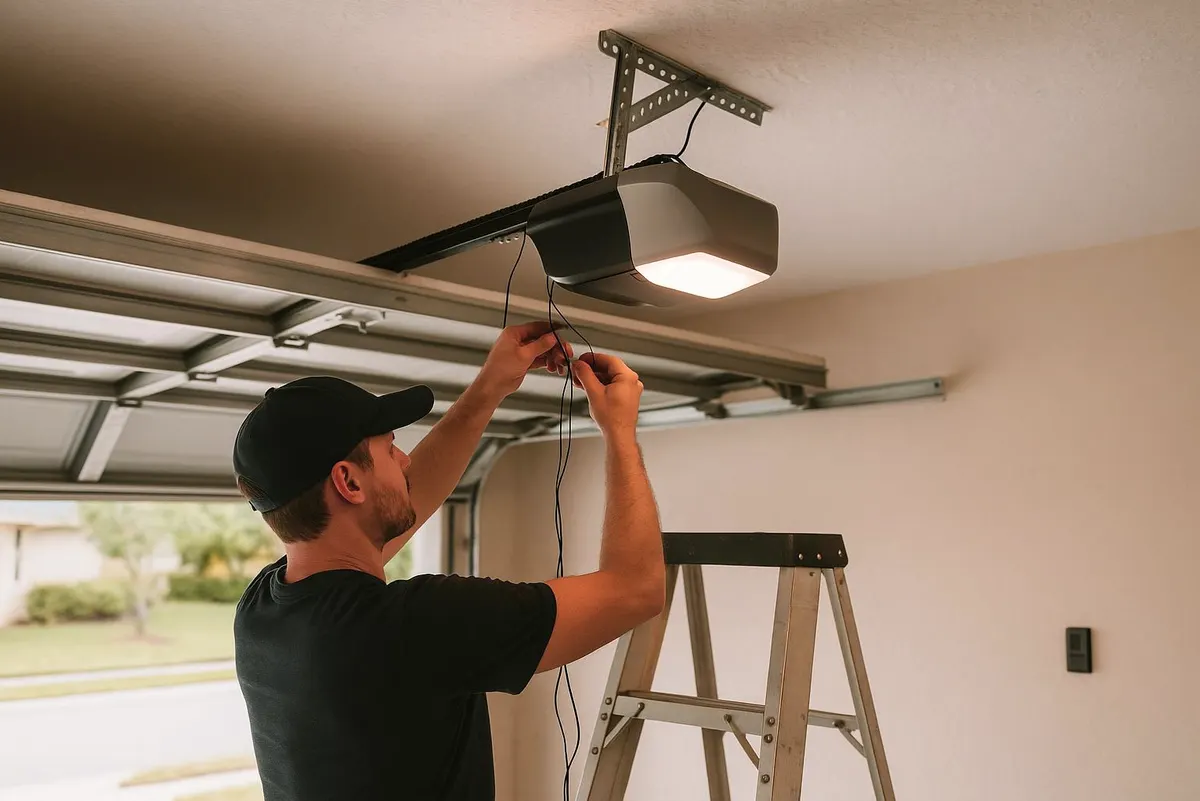
The Mistake Most Homeowners Make First
The door won't budge, the opener is groaning, and the instinct is to hit the remote button over and over or muscle the door open by hand. It's tempting because the opener sounds like it's trying — the motor hums, the chain or belt strains — so it feels like one more push will do it. But forcing a stuck door this way is how you strip the opener's drive gear, bend a track, or tear the bottom weatherstrip clean off. None of that fixes the actual problem, and now you've got a second repair on top of the first one.
Naples doesn't get hard freezes, so this usually isn't ice in the way it would be up north. What looks and feels like a door frozen to the ground is almost always moisture doing the work — condensation, humidity swelling, or a seal that's bonded itself to a damp slab overnight. The fix is different, and so is the diagnosis.
Symptoms to Notice Before You Call Anyone
- The door struggles hardest on the first opening of the day, especially after a cool, humid night or a late-afternoon downpour the day before.
- The bottom edge feels stuck or tacky, almost glued to the garage floor, and separates with a slight tug or peeling sound.
- The opener runs but the door barely lifts, or it reverses immediately like it hit an obstruction.
- The weatherstripping along the bottom looks swollen, flattened, or discolored compared to the rest of the seal.
- Rust spots show up on tracks, hinges, or roller stems, particularly if the garage is within a mile or two of the coast.
- The door moves a little rough all the way up, not just at the bottom, suggesting the whole track is slightly out of alignment.
What a Technician Checks, in Order
1. The Bottom Seal and Slab Contact
This is the first thing to rule out because it's the most common cause of a door that seems stuck to the ground in this climate. Vinyl weatherstripping absorbs moisture and swells slightly in humid conditions, and if the garage floor stays damp from overnight condensation or a storm the day before, the seal can press into the concrete and hold there by suction and surface tension alone. The fix is straightforward: clean and dry the contact strip, check whether the vinyl has swollen enough to need replacement, and make sure the seal isn't pinched under a bent bottom bracket. A fresh, correctly seated astragal usually solves this on its own.
2. Track Alignment and Panel Swelling
Wood and wood-composite doors expand with humidity, and even steel doors can shift slightly if the tracks were never perfectly plumb. In a climate that swings between soaking afternoon rain and dry heat, that expansion and contraction happens constantly, and over time it nudges rollers out of true alignment. A technician checks the gap between the door edge and the track along its full height, looking for tight spots near the bottom where swelling is most noticeable. Fixing this means loosening and resetting the track brackets, not forcing the door through a pinch point.
3. Rust and Corrosion on Hardware
Salt air works on exposed metal even a few miles inland, and galvanized hardware that isn't rated for coastal exposure corrodes faster here than it would elsewhere. Rust on roller stems or hinge pins adds friction you can feel as grinding or extra resistance, especially right after a stretch of damp weather. The check here is visual and tactile — look for orange staining, pitting, or rollers that don't spin freely by hand. The fix ranges from cleaning and lubricating light surface rust to replacing hinges and rollers that have pitted enough to bind.
4. Spring Tension and Old Lubricant
Torsion springs do respond to temperature, and even Naples' mild cool snaps can stiffen old, thickened grease enough to add noticeable resistance on the first lift of the day. A technician checks spring tension by watching how the door balances when it's manually disengaged from the opener, and inspects the lubricant on the springs and rollers for a gummy, dried-out texture instead of a smooth film. The fix is usually relubrication with a silicone-based product made for garage doors, though a spring that's lost tension or shows wear needs replacement rather than a quick fix.
5. Opener Force Settings and Sensors
If everything mechanical checks out but the opener still strains or reverses, the force and limit settings may simply be calibrated too tight for the added resistance from humidity swelling or stiff hardware. A technician checks the travel limits and down-force setting, adjusting them so the opener compensates without treating normal seasonal resistance as an obstruction. This is also when the safety sensors get tested, since a sensor misread can mimic the same stuck-door symptoms.
When to Call Naples Garage Door
If the door is sticking at the slab more than once or twice a season, or if you're seeing rust building on tracks and hinges, that's past the point of a DIY wipe-down. Our Garage Door Repair visits start with the same checklist above — seal, track, hardware, springs, opener — so the actual cause gets fixed instead of papered over. If the pattern keeps repeating every time the weather shifts, a Preventive Maintenance visit catches swelling seals, early corrosion, and worn rollers before they turn into a door that won't open on a Monday morning.
If your garage door in Naples, Marco Island, Bonita Springs, or anywhere else we serve is sticking, groaning, or struggling on cool mornings, call Naples Garage Door and we'll get it moving the right way, not the forced way.